The specs that actually decide this
| Product | Price | Drive | Speeds | Built-in speakers | Notable |
|---|---|---|---|---|---|
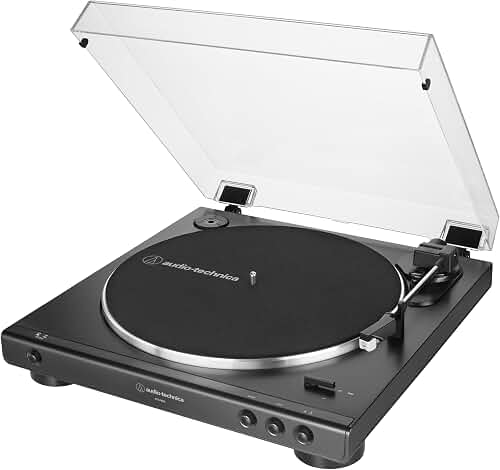
| Audio-Technica AT-LP60X-BK Fully Automatic Belt-Drive Stereo Turntable, Black, Hi-Fi, 2 Speed, Dust Cover, Anti-Resonance, Die-Cast Aluminum Platter | Check price on Amazon | Belt | 33-1/3, 45 | No | Fully automatic; anti-resonance die-cast aluminum platter; external AC adapter |
| Audio-Technica AT-LP70X Automatic Turntable (Black/Bronze) | Check price on Amazon | Belt | 33-1/3, 45 | No | AT-VM95C cartridge; switchable built-in preamp; J-shaped tonearm |
| Audio-Technica AT-LP120XUSB-BK Direct-Drive Turntable (Analog & USB) | Check price on Amazon | Direct | 33, 45, 78 | No | Fully manual; anti-skate; variable pitch; USB out; damped lift |
| 1 BY ONE High Fidelity Belt Drive Turntable with Built-in Speakers | Check price on Amazon | Belt | 33, 45 | Yes | Adjustable counterweight; magnet cartridge; Audio-Technica stylus; Bluetooth |
| Vinyl Record Player Turntable with Built-in Bluetooth Receiver & 2 Stereo Speakers (cotsoco) | Check price on Amazon | Belt | 33, 45, 78 | Yes (2) | Bluetooth in, AUX in, RCA out, headphone jack; removable cover |
| Vinyl Record Player with Speakers Vintage Turntable (seasonlife) | Check price on Amazon | Belt | 33, 45, 78 | Yes | Balanced tonearm with lift control; spring + belt anti-vibration; RCA out |
Quick answer: For most people starting a record collection, a belt-drive turntable with a proper counterweight, an adjustable or replaceable cartridge, and a real preamp path is the thing worth spending on — that combination is what protects your records and gives you sound you won't outgrow in a year. The Audio-Technica AT-LP60X-BK Fully Automatic Belt-Drive Stereo Turntable at $178.00 is the clearest example of that baseline in this group. Everything else here is a trade: cheaper and more casual, or pricier with manual control and USB recording.
Platter material, tonearm shape, and cartridge model are stated where the manufacturer states them. Where a row says nothing, assume nothing — check the listing.
The four questions that settle it
Do you want to touch the tonearm? Automatic decks start, return, and stop themselves. Manual decks make you cue and lift every side. Automatic is not "worse" — it's a convenience mechanism, and if you're playing records at breakfast it's the difference between using the thing and not.
The best turntable buyers guide for your situation depends on how you plan to use it and where.
Do you already own speakers or an amp? This is the real fork in the road. A turntable with no built-in speakers needs somewhere to go — powered speakers, a receiver, a phono input. If you have none of that, an all-in-one is the only thing that will make sound on day one.
Do you care about 78 RPM? Most modern reissues are 33-1/3, singles are 45. 78s are shellac-era records. If you've inherited a box of them, that third speed matters. Otherwise it's a spec you'll never use.
Do you want to rip records to files? Only one deck here states USB output and bundled software instructions.
Who it's for
The Audio-Technica AT-LP60X-BK Fully Automatic Belt-Drive Stereo Turntable, Black, Hi-Fi, 2 Speed, Dust Cover, Anti-Resonance, Die-Cast Aluminum Platter suits the person who is buying their first serious deck and already has — or is willing to buy — powered speakers. Audio-Technica states fully automatic belt-drive operation at 33-1/3 and 45 RPM, an anti-resonance die-cast aluminum platter, and a redesigned tonearm base and headshell for improved tracking and reduced resonance. The AC adapter handles AC/DC conversion outside the chassis, which the brand says reduces noise in the signal chain — a small design decision that tells you where the engineering attention went.
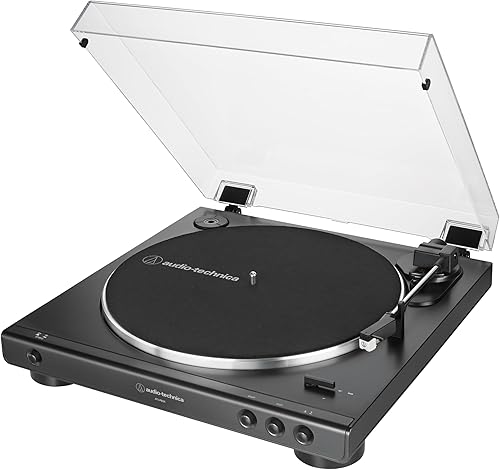
Practically, that means: put it down, plug it in, press start, walk away. The automatic return is the feature that keeps a turntable in daily use instead of in a closet. And a metal platter with resonance control is the part you can't retrofit later.
Who should skip it
Skip it if you have no speakers and no budget for them — you'll have a silent box. Skip it if you want to play 78s, because only 33-1/3 and 45 are listed. Skip it if you want to cue tracks by hand, adjust anti-skate, or set tracking force yourself; the listed feature set is about automation, not adjustment. And skip it if digitizing your collection is the point, since no USB output is stated.
Honest trade-offs
Automatic buys convenience, not adjustability. You don't get the manual controls that let you dial in tracking, and that's the deal you're making at this price.
Built-in speakers are a compromise, always. A speaker bolted to the same chassis as the stylus sits in the vibration path. All-in-ones are genuinely fun and genuinely convenient; they are not the setup you keep for a decade.
Bluetooth is not a sound-quality feature. On the units here it's an input — stream your phone through the speakers. That's a nice household feature. It has nothing to do with how your records sound.
Cheap decks and record wear. Where a manufacturer doesn't state cartridge model, stylus type, or tracking force, you can't know how gentle it is on grooves. If you own records you'd be upset to damage, that silence in the spec sheet is the answer.
What to check on the listing before you buy
Listings change more often than articles do. Before you click buy:
- Price — every figure here is a snapshot. Confirm the live price on the page.
- Variant — colorways and bundles sit under one listing and can differ in price and contents. The AT-LP120XUSB-BK is the black USB version specifically; make sure the selected swatch matches.
- What's actually in the box — the AT-LP120XUSB-BK lists USB cable, detachable RCA output cable, AC adapter, 45 RPM adapter, counterweight, felt mat, and hinged dust cover. Confirm the current listing still says so.
- Warranty and returns — check the terms and who's shipping it.
- Reviews — read them yourself, especially recent ones and anything mentioning speed accuracy or tonearm behavior. Sort by most recent, not most helpful.
Audio-Technica AT-LP70X Automatic Turntable (Black/Bronze) — consider instead if…
…you want automatic operation but with a cartridge you can upgrade. It's fully automatic belt-drive at 33-1/3 and 45 RPM with an integrated AT-VM95C cartridge that's compatible with any VM95 Series replacement stylus — meaning a genuine upgrade path without replacing the deck. It also has a switchable built-in phono preamp for phono- or line-level output, so it'll drive powered speakers directly, and a J-shaped tonearm engineered to minimize tracking errors. At $249.00 the extra spend is buying you that cartridge ecosystem and the preamp flexibility.
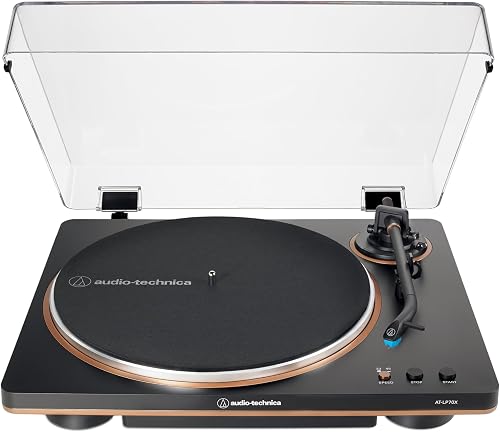
Audio-Technica AT-LP70X Automatic Turntable (Black/Bronze)
Audio-Technica AT-LP120XUSB-BK Direct-Drive Turntable (Analog & USB), Fully Manual, Hi-Fi, 3 Speed, Convert Vinyl to Digital, Anti-Skate and Variable Pitch Control, Black — consider instead if…
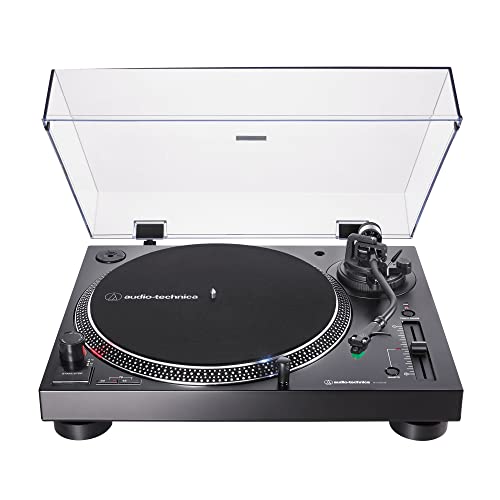
…you want to learn the craft or digitize a collection. It's a direct-drive DC servo motor with 33/45/78 RPM, fully manual, with adjustable dynamic anti-skate, variable pitch control with quartz speed lock, and a balanced S-shaped tonearm with hydraulically damped lift and lockable rest. It converts vinyl to digital via USB using free Mac- and PC-compatible Audacity software. At $349.00 it's the one with 78 RPM and the one that rewards fiddling.
1 BY ONE High Fidelity Belt Drive Turntable with Built-in Speakers — consider instead if…
…you need sound out of the box but don't want a toy. At $169.99 it spins 33 and 45, has built-in speakers plus a built-in amplifier for connecting your own powered speakers, an adjustable counterweight and magnet-type cartridge with a diamond-tipped Audio-Technica stylus, and Bluetooth for streaming from phones and tablets. The counterweight is the meaningful part — it's the control most all-in-ones omit.
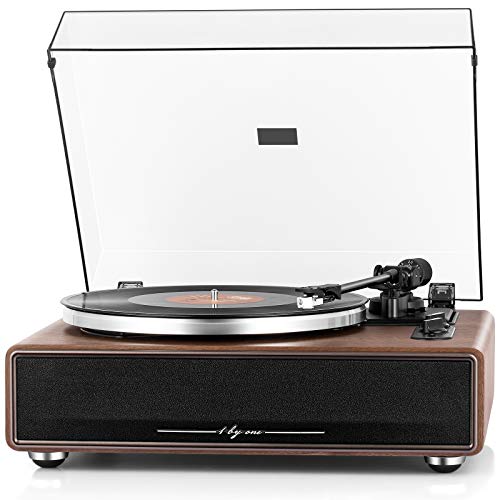
1 BY ONE High Fidelity Belt Drive Turntable with Built-in Speakers
Vinyl Record Player Turntable with Built-in Bluetooth Receiver & 2 Stereo Speakers, 3 Speed 3 Size Portable Retro Record Player for Entertainment and Home Decoration — consider instead if…
…$29.99 is the budget and you want maximum connectivity. It has Bluetooth input, AUX in, RCA line-out, and a headphone jack, with two built-in stereo speakers, belt drive at 33/45/78 RPM for 7", 10" and 12" records, and a removable dust cover. The RCA out means you can feed external speakers later. Treat it as a gift or a first taste, not a home for records you love.
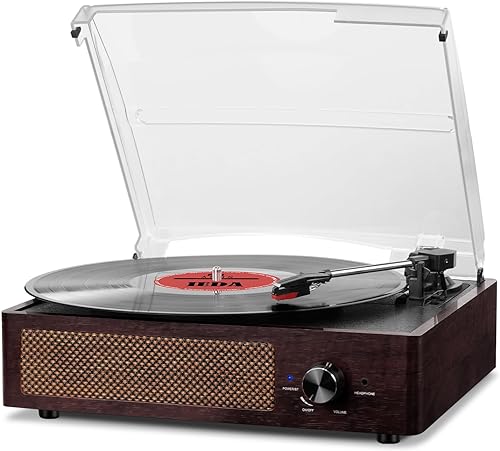
Vinyl Record Player with Speakers Vintage Turntable for Vinyls Records Belt-Driven Turn Table Support 3-Speed, Wireless Playback, Headphone, AUX-in, RCA Line LP Phonograph for Sound Enjoyment Black — consider instead if…
…you want the same $29.99 entry point with a lift control. It lists a balanced tonearm with lifting arm control, 33-1/3/45/78 RPM across 7", 10" and 12" records, a spring and belt-driven anti-vibration base, a removable dust cover, wireless input pairing, and RCA output to external powered speakers. The manual lift is worth something — it's how you avoid dropping a stylus onto a record.
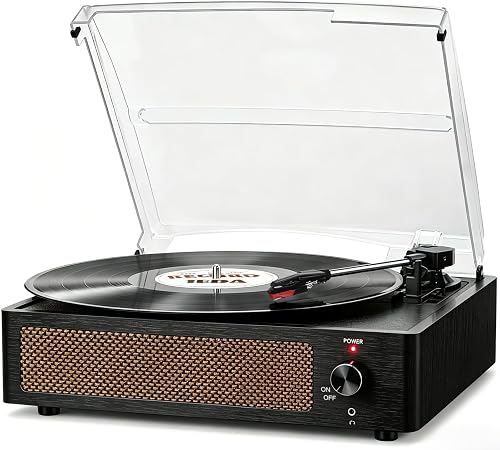
FAQ
Do I need a separate preamp? It depends on the deck and what you're plugging into. The AT-LP70X lists a switchable built-in phono preamp with phono- or line-level output, so it can feed powered speakers directly. If a turntable doesn't state a built-in preamp and your speakers don't have a phono input, you need one in between — otherwise the sound will be thin and very quiet.
Belt drive or direct drive? Belt drive uses a rubber belt between motor and platter, which isolates motor vibration. Direct drive spins the platter from the motor itself — the AT-LP120XUSB-BK pairs that with a quartz speed lock and pitch control, the setup DJs want for instant, stable speed. For home listening at these prices, either is fine; buy for the features around the drive, not the drive type.
Will a cheap turntable damage my records? The honest answer is that you can't tell from a listing that doesn't specify stylus type and tracking force. Decks that state a real cartridge and an adjustable counterweight — the 1 BY ONE, or the AT-LP70X with its AT-VM95C — give you something concrete to evaluate. Keep irreplaceable records off anything you can't verify.
Is 78 RPM worth paying for? Only if you own 78s. Among these, the AT-LP120XUSB-BK and both $29.99 all-in-ones list all three speeds; the AT-LP60X-BK and AT-LP70X list two.
Related guides
- How Tonevale Researches Products
- How To Set Record Player Weight (2026)
- Best home audio and home theater - bluetooth speakers, soundbars, AV receivers, turntables and record players with Limited History
Key Takeaways
- Choosing the right turntable buyers guide means matching the key features to your specific needs and budget
- Read real customer reviews and check the return policy before you commit
- Compare value across models — the priciest option is not always the best fit