What goes wrong, and how to fix it
| Symptom | Cause | Fix |
|---|---|---|
| Barely audible, thin, no bass | Phono output into a line input | Switch to LINE, or use a phono preamp |
| Distorted, bloated, overloaded | Line output into a PHONO input | Switch to PHONO, or use a normal AUX input |
| Loud hum or buzz | Ground wire not connected | Attach ground spade to the amp's GND post |
| Stylus skips forward | Tracking force too low, or unlevel deck | Rebalance counterweight; level the plinth |
| Pitch wavers (wow) | Twisted belt, or transit spacer left in | Reseat the belt flat; remove packing |
| One channel harsh on loud passages | Anti-skate mis-set | Match anti-skate to tracking force |
| Record skips when you walk past | Deck is on a resonant surface | Move to a rigid shelf, away from speakers |
| Bass feedback howl at volume | Turntable too close to speakers | Increase distance or isolate the plinth |
Quick answer: Setting up a turntable takes about 20 minutes: level the surface, seat the platter and belt, balance the tonearm, set anti-skate, then route the output through a phono preamp before it hits your speakers. The two things that ruin most first-time setups are an unbalanced tonearm and plugging a phono-level output into a line-level input. Get those right and everything else is detail work.
What you need before you start
- A rigid, level surface — a shelf or heavy table, not a hollow IKEA cube next to your subwoofer
- A small bubble level (a phone app works in a pinch)
- A stylus force gauge if your turntable has an adjustable counterweight (optional but useful)
- RCA cables, and a phono preamp — either built into the turntable, built into your receiver, or a separate box
- Ten minutes of patience for the counterweight step
Step-by-step setup
1. Pick and level the surface
Vinyl is a mechanical format. Every vibration that reaches the plinth reaches the stylus. Put the turntable somewhere solid and away from your speakers — especially away from a subwoofer sitting on the same wooden floor.
Gotcha: People level the plinth and forget the surface underneath sags under load. Level it after the turntable is sitting there, not before.
The best how to set up a turntable for your situation depends on how you plan to use it and where.
2. Unbox without bending the tonearm
Remove the transit screws or cable ties on the platter and tonearm before you do anything else. The tonearm usually ships locked to its rest with a twist tie. Cut it, don't yank it.
Gotcha: Some belt-drive decks ship with a cardboard spacer under the platter. If you leave it in, the platter will wobble and the speed will drift.
3. Seat the platter and loop the belt
Drop the platter onto the spindle. On belt-drive models you'll see one or two cutouts in the platter — reach through, grab the belt, and loop it over the motor pulley. It should sit flat, not twisted.
Gotcha: A twisted belt produces an audible wow every revolution. Spin the platter by hand a full turn and watch the belt before you put the mat on.
4. Mount the headshell and cartridge
If your headshell detaches, slide it into the tonearm collar and tighten the locking ring — firm, not gorilla-tight. Then remove the stylus guard last, after all the fiddly work is done.
Gotcha: More styli die during setup than during playback. Leave the plastic guard on until step 7.
5. Balance the tonearm
This is the step people skip. With anti-skate at zero, rotate the counterweight until the tonearm floats level, hovering on its own without drifting up or down. Then, holding the counterweight still, zero the numbered ring on it. Now dial the counterweight to the tracking force your cartridge specifies — usually somewhere around 2 grams for a moving-magnet cartridge, but check your manual, not the internet.
Gotcha: Too light is far more damaging than slightly heavy. A stylus that skates and mistracks carves the groove walls. Fully automatic decks like the Audio-Technica AT-LP60X-BK are preset at the factory and skip this step entirely.
6. Set anti-skate
Set the anti-skate dial to roughly the same number as your tracking force. It counteracts the inward pull the groove exerts on the arm. Manual decks with a dedicated dial — the Audio-Technica AT-LP120XUSB-BK has adjustable dynamic anti-skate — let you fine-tune this.
Gotcha: If sound is louder or cleaner in one channel during loud passages, anti-skate is usually the culprit, not your cartridge.
7. Get the signal to a preamp
A turntable cartridge outputs a signal roughly 1,000× quieter than a line-level source, with a frequency curve (RIAA) that has to be reversed. Three valid paths:
- Turntable has a built-in switchable preamp — set the switch to LINE and plug into any AUX input. The Audio-Technica AT-LP70X includes a switchable phono preamplifier for exactly this.
- Your receiver has a PHONO input — set the turntable switch to PHONO and use that input, plus the ground wire.
- Neither — you need an external phono stage between the two.
8. Attach the ground wire, then play a record
If there's a thin spade-terminal wire, screw it to the GND post on your amp. Set the speed selector to 33 for a 12-inch LP, 45 for a 7-inch single, and use the puck adapter for wide-hole singles. Lower the cueing lever gently.
Spec and compatibility comparison
| Model | Price | Drive | Speeds | Built-in preamp | Built-in speakers | Wireless | Operation |
|---|---|---|---|---|---|---|---|
| Audio-Technica AT-LP60X-BK | Check price on Amazon | Belt | 33-1/3, 45 | Not stated | No | Not stated | Fully automatic |
| Audio-Technica AT-LP70X | Check price on Amazon | Belt | 33-1/3, 45 | Yes, switchable | Not stated | Not stated | Fully automatic |
| Audio-Technica AT-LP120XUSB-BK | Check price on Amazon | Direct drive | 33, 45, 78 | Not stated | Not stated | Not stated | Fully manual |
| 1 BY ONE High Fidelity Belt Drive Turntable | Check price on Amazon | Belt | 33, 45 | Built-in amplifier | Yes | Bluetooth | Not stated |
| cotsoco Vinyl Record Player Turntable | Check price on Amazon | Belt | 33, 45, 78 | Not stated | Yes (2 stereo) | Bluetooth | Not stated |
| seasonlife Vinyl Record Player with Speakers | Check price on Amazon | Belt | 33-1/3, 45, 78 | Not stated | Yes | Wireless | Not stated |
Check current listings for anything marked "Not stated" — and read owner reviews yourself before buying, since long-term reliability is the one thing a spec sheet never tells you.
When the fix is a new one
Sometimes the setup problem is the deck. A turntable with no counterweight, no anti-skate and a ceramic cartridge can't be dialed in — there's nothing to dial.
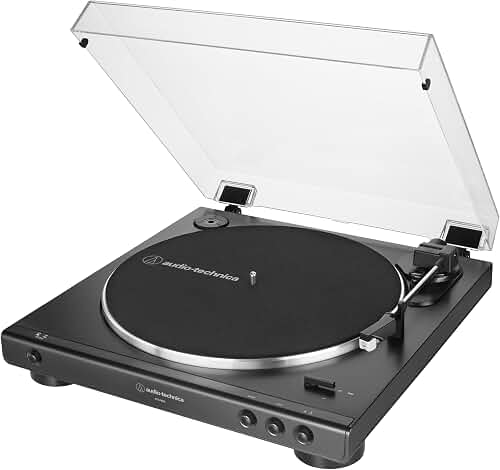
Audio-Technica AT-LP60X-BK Fully Automatic Belt-Drive Stereo Turntable, Black, Hi-Fi, 2 Speed, Dust Cover, Anti-Resonance, Die-Cast Aluminum Platter — removes the hardest steps entirely
Fully automatic operation means the arm cues, plays and returns on its own, so the counterweight and anti-skate steps disappear from your setup. Its anti-resonance die-cast aluminum platter and redesigned tonearm base target the resonance problems that cause skipping, and the external AC adapter keeps conversion noise out of the signal chain. See the Audio-Technica AT-LP60X-BK Fully Automatic Belt-Drive Stereo Turntable for the full listing.
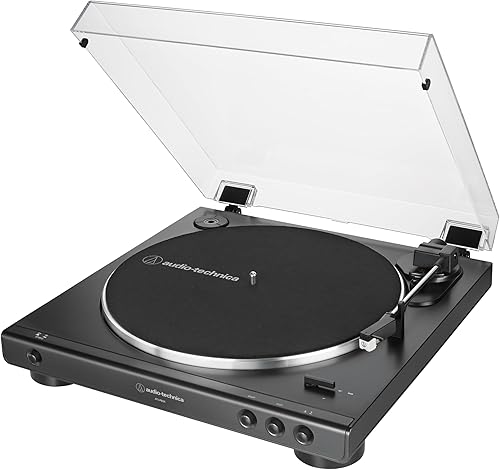
Audio-Technica AT-LP70X Automatic Turntable (Black/Bronze) — solves the preamp-matching problem
The switchable phono preamplifier means you choose phono- or line-level output at a switch, which eliminates the most common wiring mistake in this whole guide. The integrated AT-VM95C cartridge accepts any VM95 Series replacement stylus, so a worn stylus is a two-minute swap rather than a new cartridge alignment job, and the J-shaped tonearm is engineered to minimize tracking errors. Details on the Audio-Technica AT-LP70X Automatic Turntable.
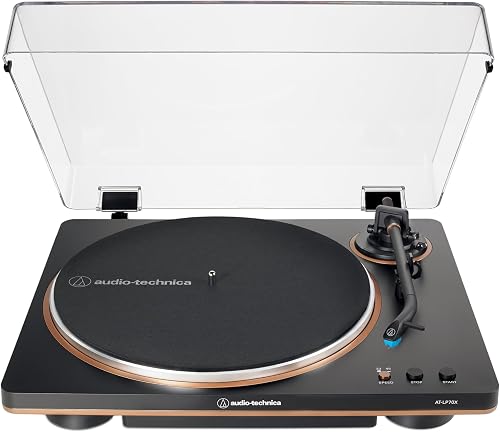
Audio-Technica AT-LP120XUSB-BK Direct-Drive Turntable — gives you every adjustment to actually tune
Fully manual with adjustable dynamic anti-skate, variable pitch control with quartz speed lock, and a balanced S-shaped tonearm with hydraulically damped lift — this is the deck for people who want the setup steps. The direct-drive DC servo motor adds 78 RPM, and it converts vinyl to digital over USB using free Audacity software. Box includes the USB cable, detachable RCA output cable, AC adapter, 45 RPM adapter, counterweight, felt mat and hinged dust cover. See the Audio-Technica AT-LP120XUSB-BK Direct-Drive Turntable.
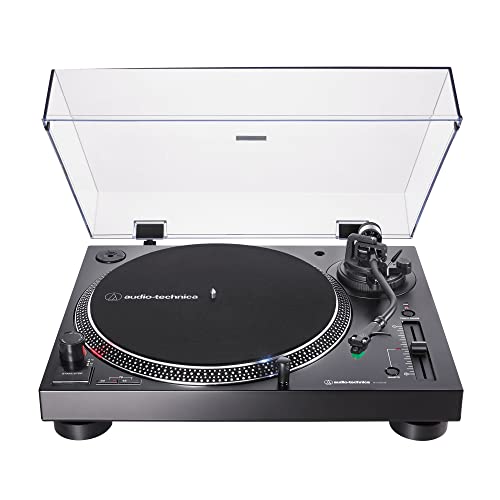
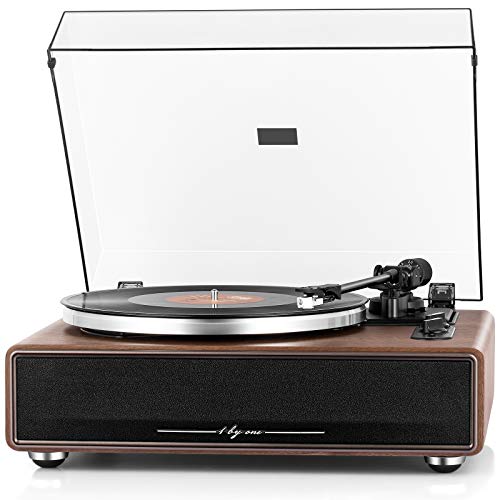
1 BY ONE High Fidelity Belt Drive Turntable with Built-in Speakers — one box, but still adjustable
It has an adjustable counterweight and a magnet-type cartridge with an Audio-Technica diamond-tipped stylus, so you can actually balance the arm — unusual at this price for an all-in-one. Built-in speakers plus a built-in amplifier mean no separate system needed, and Bluetooth plus Aux-in handle non-vinyl sources. Spins 33 and 45. Listing: 1 BY ONE High Fidelity Belt Drive Turntable.
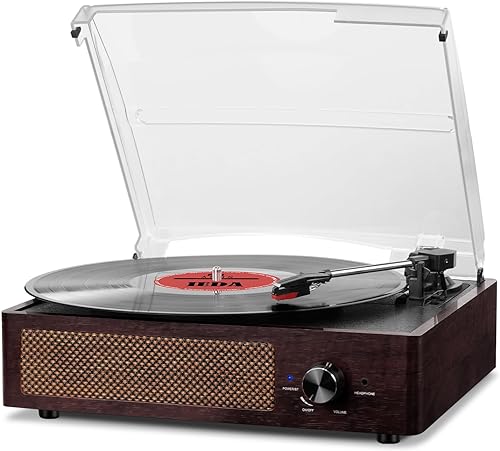
cotsoco Vinyl Record Player Turntable — the simplest possible starting point
Three speeds (33, 45, 78) across 7", 10" and 12" records, two built-in stereo speakers, and Bluetooth, AUX, RCA line-out and a headphone jack. The manufacturer notes to tilt a 12-inch record gently toward the tonearm when placing it. RCA line-out is the escape hatch if you outgrow the internal speakers. See the cotsoco Vinyl Record Player Turntable with Built-in Bluetooth Receiver.
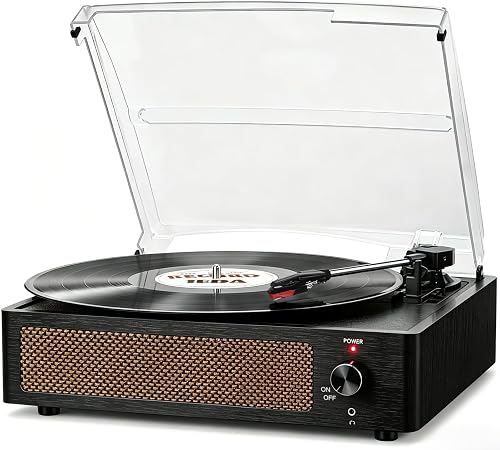
seasonlife Vinyl Record Player with Speakers — spring-isolated base at entry price
The base uses a spring and belt-driven design for shock absorption, which is the right idea for the "skips when someone walks past" problem. Balanced tonearm with lifting arm control, three speeds and three record sizes, wireless pairing, AUX, headphone out and RCA line-out to powered speakers. Full details on the seasonlife Vinyl Record Player with Speakers.
FAQ
Do I need a phono preamp? Yes — the question is only where it lives. It's either inside the turntable, inside your receiver (a PHONO input), or a separate box. If your sound is quiet and bass-less, you don't have one in the chain.
How do I know if my tracking force is right? Follow the cartridge manufacturer's spec, not a generic number. If you have no gauge and no spec, an automatic turntable that's factory-preset removes the guesswork.
Can I stack records on the platter? No. Records need to sit flat on the mat. Stacking scratches the surfaces and changes the effective platter height, which throws off the tonearm's vertical angle.
Does the dust cover need to be closed while playing? It's a trade-off. Closed keeps dust off but can resonate at volume; open avoids that but exposes the record. Most people close it between plays and leave it open during them.
Related guides
- How to Build a Home Theater System From Scratch
- Expert Advice on Best home audio and home theater - bluetooth speakers, soundbars, AV receivers, turntables and record players
- How to Succeed with Best home audio and home theater - bluetooth speakers, soundbars, AV receivers, turntables and record players
Key Takeaways
- Choosing the right how to set up a turntable means matching the key features to your specific needs and budget
- Read real customer reviews and check the return policy before you commit
- Compare value across models — the priciest option is not always the best fit