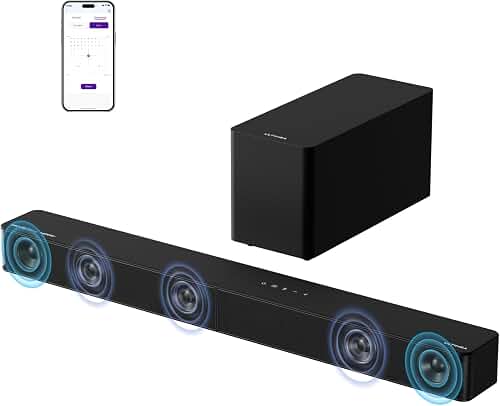
Specification comparison
| Product | Configuration | Rated power | Subwoofer | Stated inputs | Price |
|---|---|---|---|---|---|
| ULTIMEA 5.1CH Surround Sound Bar w/Dolby Atmos, for Home Theater | 5.1ch, Dolby Atmos, 6-driver system | 300W peak | Wired wooden sub, 18 mm high-excursion driver, 5.3 L cabinet | HDMI eARC (37 Mbps), CEC | Check price on Amazon |
| ULTIMEA Sound Bar with Wireless Subwoofer, App Control, for Home Theater | 2.1ch | 240W peak | Wireless, 18 mm high-excursion driver, 6.5 L cabinet | Not stated | Check price on Amazon |
| Bose TV Speaker - Soundbar for TV with Bluetooth and HDMI-ARC Connectivity | 2 angled full-range drivers, all-in-one | Not stated | None (all-in-one bar) | HDMI, optical in, AUX in, Bluetooth | Check price on Amazon |
| Samsung B-Series Soundbar HW B400F 2.0 ch | 2.0ch with built-in woofer | Not stated | Built-in woofer | Not stated | Check price on Amazon |
| TCL S45H 2.0 Sound Bar | 2.0ch, Dolby Atmos, DTS Virtual:X | Up to 100W | Not stated | HDMI eARC/ARC, optical, Bluetooth, AUX | Check price on Amazon |
| Assistrust Sound Bar for Smart TV, 2 in 1 Detachable Soundbar | 4 drivers, detachable two-piece | 80W | Not stated | Bluetooth 5.0, ARC, optical, AUX | Check price on Amazon |
Quick answer: For most rooms, the two specs that decide whether you'll be happy are the connection (HDMI eARC/ARC beats optical and Bluetooth for TV audio) and whether there's a real subwoofer instead of a "built-in bass" claim. Everything else — Dolby Atmos badges, wattage numbers, app control — matters less than getting dialogue clear and bass that doesn't rattle the cabinet. Below is a spec comparison of six current soundbars plus the questions worth asking before you spend anything.
The specs that actually change what you hear
Connection type. HDMI eARC carries lossless formats and lets your TV remote control volume via CEC. Plain ARC works but has less bandwidth. Optical is fine for stereo and compressed surround. Bluetooth is for music, not for watching TV — latency ruins lip sync unless the manufacturer specifically addresses it.
Channel count. A "2.0" bar is left and right, nothing else. "2.1" adds a subwoofer. "5.1" adds surround channels. More channels only help if the bar has drivers physically aimed to produce them.
The best soundbar buying guide for your situation depends on how you plan to use it and where.
Subwoofer: separate, wireless, wired, or built-in. A separate sub in its own cabinet moves far more air than a woofer crammed into a slim bar. Wireless subs are easier to place; wired subs need a cable run but never drop the link.
Dialogue processing. If "I can't hear what they're saying" is why you're shopping, look for a named dialogue mode rather than assuming more watts will fix it. It usually won't.
The reference point: a 5.1 bar with a real subwoofer
If you want one configuration to measure everything else against, it's the ULTIMEA 5.1CH Surround Sound Bar w/Dolby Atmos, for Home Theater at $129.99. It's the only option here that lists a genuine 5.1-channel layout with two side-firing drivers, a dedicated wooden subwoofer, HDMI eARC, and a stated frequency response of 45 Hz–18 kHz with a 99 dB maximum SPL. Those are the numbers that separate "TV speakers, but louder" from something resembling a home theater.
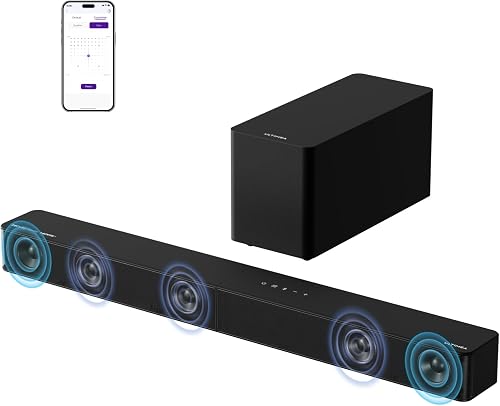
Two details worth knowing. First, the subwoofer is wired, not wireless — you're running a cable from the bar to the sub, so plan placement accordingly. Second, the surround effect comes from side-firing drivers rather than rear speakers, which is a physics compromise no marketing term erases. It widens the soundstage; it does not put a helicopter behind your head.
Who it's for
- You watch movies and want low-end you can feel, not just hear.
- Your TV has an HDMI eARC port and you'd like the full bandwidth it offers.
- Dialogue clarity is a priority — the VoiceMX processing targets vocal frequencies specifically.
- You're gaming and care about latency; the listing states under 0.5 ms DSP latency.
Who should skip it
- You live in an apartment with thin walls. A 5.3 L subwoofer cabinet tuned down to 45 Hz is exactly what your neighbours will complain about. A 2.0 bar is the socially responsible choice.
- You have no HDMI eARC port. The eARC bandwidth is the headline feature; on an older TV you're paying for capability you can't use.
- You need a clean, cable-free room. The wired sub means a visible cable unless you can hide it.
- Your problem is only dialogue. A compact bar solves that for less money and less clutter.
The honest trade-offs
Wattage numbers are close to meaningless across brands. "300W peak" and "80W" are measured differently by different manufacturers. Compare frequency response and SPL where they're published — the ULTIMEA models list 45 Hz–18 kHz and 99 dB / 95 dB maximums; Bose, Samsung and TCL don't state comparable figures, which isn't a defect, just a gap you can't reason across.
Virtual Atmos is not Atmos. The TCL S45H lists Dolby Atmos and DTS Virtual:X from a 2.0 bar with no height drivers. It's processing that simulates height. Some people find it convincing; others hear it as a phasey widening effect. Judge with your own ears in the return window.
Cheap bars often skip the spec sheet. The Assistrust bar at $49.99 lists 80W and four drivers but no channel count, no frequency response, and no SPL figure. That's normal at the price. It's also why you should treat it as a "better than TV speakers" upgrade rather than a home theater purchase.
Brand ecosystem lock-in cuts both ways. The Samsung HW-B400F's One Remote control works with a Samsung TV. On any other brand you lose that convenience.
What to check on the listing before you buy
Listings change constantly, so verify these yourself rather than trusting any article — including this one:
- Current price. Every figure above is a snapshot. Soundbars move in price more than almost any audio category.
- Which variant is selected. Several of these families sell multiple configurations under near-identical names. Confirm the channel count and whether a subwoofer is included in the exact variant in your cart.
- What's in the box. The Bose TV Speaker listing states an optical cable is included and an HDMI cable is sold separately. Assume nothing.
- Warranty terms. Assistrust states an 18-month warranty, 24/7 online support and a 60-day replacement policy. Others don't publish terms on the listing — check before, not after.
- Read the recent owner reviews and the Q&A yourself, filtered to the newest ones and to your specific TV brand. That's where connection quirks surface.
Consider instead if…
ULTIMEA Sound Bar with Wireless Subwoofer, App Control, for Home Theater — consider instead if…
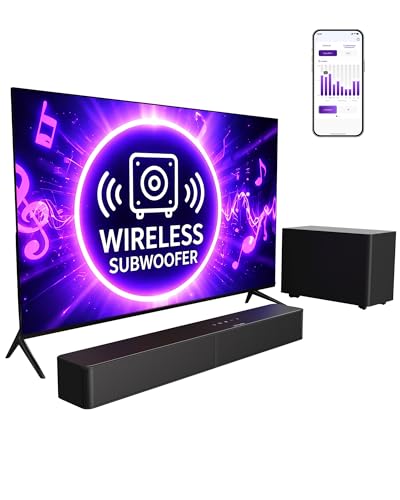
…you want a real external subwoofer without a cable running across the floor. The ULTIMEA Sound Bar with Wireless Subwoofer, App Control, for Home Theater is $69.99 for a 2.1 system with a wireless sub built around an 18 mm high-excursion driver in a 6.5 L cabinet — physically larger than the wired sub in the 5.1 model — plus mica-reinforced diaphragms, VoiceMX dialogue enhancement and app control. Trade-off: no Atmos and no surround channels are stated, and the listing doesn't specify HDMI, so confirm inputs before ordering.
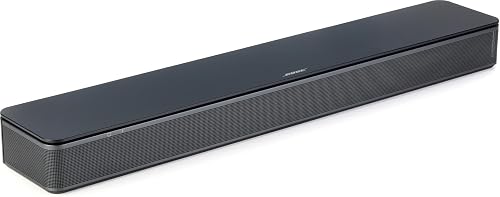
Bose TV Speaker - Soundbar for TV with Bluetooth and HDMI-ARC Connectivity, All-in-One Compact Soundbar, Includes Remote Control, Black — consider instead if…
…you want the simplest possible fix for muddy TV dialogue and you'd rather pay for tuning than for spec-sheet numbers. The Bose TV Speaker is $279.00, uses two angled full-range drivers, includes a remote and an optical cable, and connects over HDMI, optical or AUX with Bluetooth for music. It's the priciest option here and has no subwoofer at all — you're buying compactness and voice clarity, not bass.
Samsung B-Series Soundbar HW B400F 2.0 ch Soundbar with Built in Subwoofer (2025 Model) One Remote Control, Surround Sound Expansion, Voice Enhance Mode — consider instead if…
…you own a Samsung TV and want one remote to run everything. The Samsung HW-B400F is $117.99, a 2025-model 2.0-channel bar with a built-in woofer, Voice Enhance Mode for dialogue, and Surround Sound Expansion. Built-in bass will never match a separate sub cabinet, but you get a single-box install with no second unit to place.
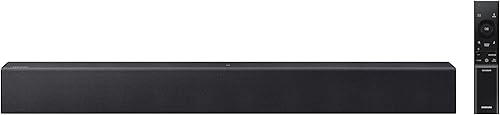
TCL S45H 2.0 Sound Bar for Smart TV | Dolby Atmos DTS:X Auto Room Calibration| 100W Power Wireless Bluetooth Home Theater Audio | App & Remote Control | Latest Model — consider instead if…
…you're in an apartment or bedroom where a subwoofer is a bad idea, but you still want spatial processing. The TCL S45H is $79.99 with up to 100W, Dolby Atmos and DTS Virtual:X, HDMI eARC/ARC plus optical, Bluetooth and AUX, and AI Sonic auto room calibration run once through the TCL app. It's the most connection-flexible small bar in this group.

Assistrust Sound Bar for Smart TV, Soundbar with Bluetooth/ARC/Opt/AUX Connect, Auto Volume Boost, 3 Equalizer Modes, 2 in 1 Detachable Soundbar for TV/PC/Gaming/Projectors — consider instead if…
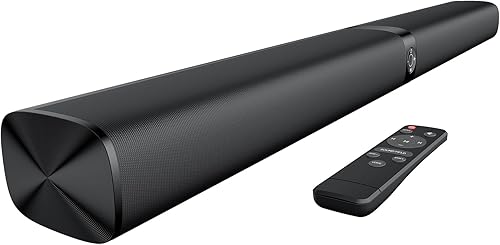
…your budget is genuinely tight or the bar is for a PC, dorm or projector setup. The Assistrust Sound Bar is $49.99 with 80W across four drivers, three EQ modes (movie, music, news), automatic volume boost, and Bluetooth 5.0 alongside ARC, optical and AUX. It splits into two pieces for horizontal, vertical, tabletop or wall placement, and the listing states an 18-month warranty with a 60-day replacement policy. Expect a clarity upgrade over TV speakers, not cinema bass.
FAQ
Do I need HDMI, or is optical fine? Optical is fine if you're mainly watching broadcast TV and streaming in stereo or compressed surround. You need HDMI eARC — not just ARC — if you want lossless Dolby Atmos; the ULTIMEA 5.1CH listing cites 37 Mbps of eARC bandwidth for exactly that reason. eARC also enables CEC, so your TV remote controls the soundbar.
When is a good time to buy a surround sound system? Audio gear discounts cluster around the major retail sale events and around model-year transitions, when the previous generation clears out. Since prices on these listings change frequently, set a price alert rather than guessing — and check whether a "2025 model" designation like the Samsung HW-B400F's means a genuinely newer product or just a refreshed part number.
Is a 2.1 system with a subwoofer better than a 5.1 bar without one? Neither is automatically better. A 2.1 setup with a large dedicated sub gives you more convincing low end; a 5.1 bar spreads sound wider. If you watch mostly movies with big effects, prioritise the sub. If you want envelopment across a wide sofa, prioritise the channel count.
How much do I need to spend to hear a real difference over TV speakers? The jump from flat-panel TV speakers to almost any dedicated bar is the largest single improvement — that's true even at the $49.99 end. The gains after that are real but progressively smaller, so decide what specifically bothers you (dialogue, bass, width) and buy for that one thing.
Related guides
How we research: we don't do hands-on testing. Recommendations on this page are based on manufacturer specifications and Amazon's official product data (via Amazon's Creators API), checked on 2026-07-29. Prices can change on Amazon at any time.Key Takeaways
- Choosing the right soundbar buying guide means matching the key features to your specific needs and budget
- Read real customer reviews and check the return policy before you commit
- Compare value across models — the priciest option is not always the best fit