Comparison table
| Receiver | Channels | Power | Max video | Room correction | Price |
|---|---|---|---|---|---|
| Yamaha RX300A | 5.2 | 70W | 4K/120, 8K/60 | Included setup mic | Check price on Amazon |
| Denon AVR-S570BT | 5.2 | 70W x 5 | 8K via 4 HDMI 2.1 inputs | Not stated | Check price on Amazon |
| Sony STRDH590 | 5.2 | Not stated | 4K HDR pass-through | Not stated | Check price on Amazon |
| Yamaha RX-V6A | 7.2 | Not stated | 4K120, 8K60 | Not stated | Check price on Amazon |
| Denon AVR-X1700H | 7.2 | 80W/ch | 8K/60, 4K/120 | Not stated | Check price on Amazon |
| Onkyo TX-RZ50 | 9.2 | Not stated | Not stated | Dirac Live | Check price on Amazon |
Quick answer: For most people building a real surround system, the Denon AVR-X1700H is the sweet spot — 7.2 channels, 80W each, and three 8K inputs at $699.99. If you're spending as little as possible and still want Dolby Atmos, the $399.95 Yamaha RX300A does it. And if you want THX certification with Dirac Live room correction, the Onkyo TX-RZ50 is the step up.
An AV receiver is the least glamorous box in a home theater and the one that decides whether the whole thing works. It switches your video, decodes the audio, powers your speakers, and handles streaming. Buy the wrong one and you'll discover it in eighteen months when your new console won't pass 4K/120 through it. Here's what actually separates these six.
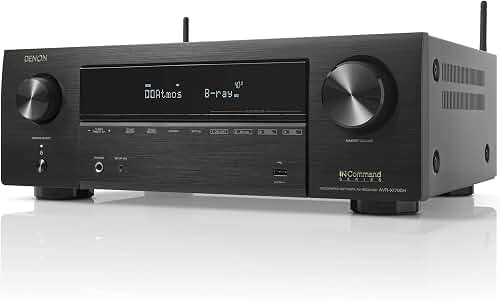
Denon AVR-X1700H — Best Overall
Seven channels at 80W apiece is the configuration that makes a real difference over the 5.2 units below it. You get a genuine 5.1.2 Atmos layout — five speakers on the floor, two overhead — instead of having to pick between surrounds and heights.
Finding the right best av receivers home theater comes down to matching the features to how you will actually use it.
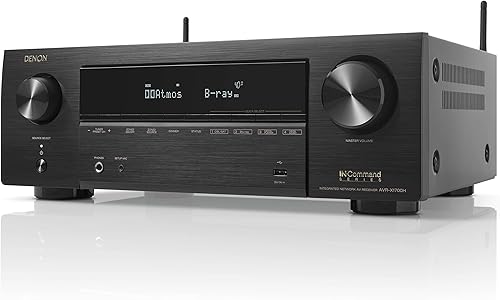
Video is where it earns the extra money. There are three dedicated 8K inputs and one output handling 8K/60Hz and 4K/120Hz pass-through, plus 8K upscaling on all six inputs, HDCP 2.3, Dynamic HDR, QMS, and 4:4:4 color sub-sampling. HDR10, HDR10+, Dolby Vision and HLG are all supported. On the audio side it adds Dolby Atmos, DTS:X, DTS Virtual:X and Dolby Atmos Height Virtualization, which fakes overhead effects if you never get around to mounting height speakers.
Built-in HEOS covers multi-room and multi-source streaming — someone can watch a movie in the living room while someone else streams Spotify, Pandora or Amazon Music HD in another zone over Wi-Fi, AirPlay 2 or Bluetooth. Alexa voice control is built in, and the on-screen setup guide plus color-coded back panel makes the wiring far less miserable than it usually is.
Get it if: you want one receiver that won't need replacing when your TV, console or speaker count changes.
Denon AVR-X1700H 7.2 Channel AV Receiver
Yamaha RX300A — Best Budget Dolby Atmos
At $399.95 this is the cheapest way onto this list that still gives you real Dolby Atmos decoding. It's 5.2 channels at 70W, and Yamaha lets you configure a 3.1.2 layout using either up-firing modules or in-ceiling height speakers — so the overhead layer is genuinely on the table, not just virtualized. DTS Virtual:X is there too when you're running fewer speakers.
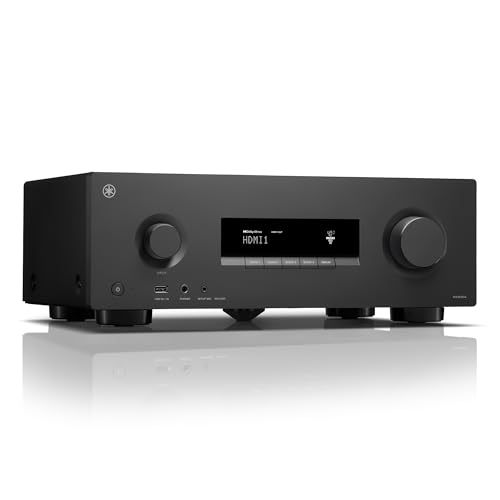
Video keeps pace with hardware that costs a lot more: 4K/120 and 8K/60 pass-through, Dolby Vision, HDR10+, HDMI eARC/ARC, and the gaming features that actually matter — ALLM and VRR. A setup microphone is included, and the receiver measures your room and speaker characteristics to correct automatically, which matters more in an awkward room than another 10 watts ever will.
The nice touch is Bluetooth Multipoint: you can pair two source devices and switch between them instantly, so your phone and your partner's don't fight over the connection.
Get it if: you want Atmos and next-gen gaming support for under $400 and can live with five channels.
Yamaha RX300A 5.2-Channel Home Theater AV Receiver
Denon AVR-S570BT — Best for Gaming Inputs
The pitch here is HDMI ports. Four HDMI 2.1 8K inputs at $449 is more 8K-capable inputs than anything else near this price, which matters if you've got a console, a PC and a streaming box all wanting the good port. There's one output with eARC up to 40 Gbps.
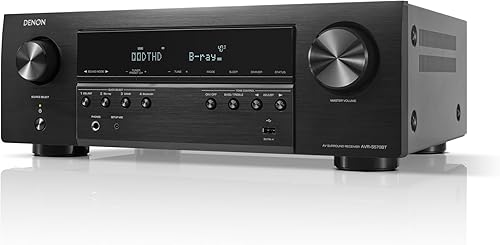
It's 5.2 channels at 70W x 5, with VRR and QFT for lag-free gaming, and HDR, HLG, Dolby Vision, HDR10+ and Dynamic HDR on the video side. Audio decoding covers DTS-HD Master Audio and Dolby TrueHD in a 5.1 surround configuration. Note what isn't listed: Denon specifies 5.1 surround here, not Atmos — if the overhead layer is your priority, look at the RX300A or the X1700H instead.
Setup runs through Denon's on-screen HD Setup Assistant, and you can either control it with your smart TV remote via HDMI-CEC or use the Denon Remote App on iOS and Android. Bluetooth streaming from Spotify, TIDAL and Pandora is built in. Power draw is rated 310W in use and 0.1W in standby.
Get it if: you have more 8K/4K120 sources than most receivers have inputs.
Denon AVR-S570BT AV Receiver 5.2 Channel 8K
Yamaha RX-V6A — Best for Whole-Home Streaming
This is the streaming-first pick. MusicCast multi-room is built in alongside Wi-Fi, Bluetooth, AirPlay 2 and Spotify Connect, with direct support for Pandora, Napster, SiriusXM, TIDAL, Deezer, Qobuz and Amazon Music HD. Voice control works through Alexa and Google Assistant devices, or Siri via AirPlay 2.
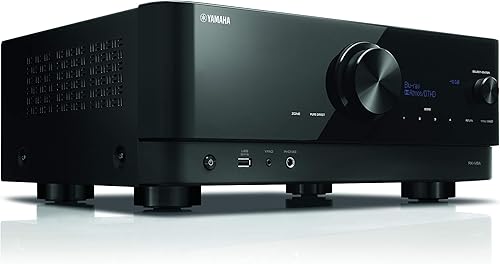
The HDMI section is generous: seven inputs and one output with HDCP 2.3 and eARC, three of them 8K-capable, handling 4K60, 4K120 and 8K60 over HDMI 2.1. At 7.2 channels it can drive the same speaker counts as the Denon X1700H. Yamaha doesn't state power per channel in the listing, so if you're pairing it with demanding speakers, check the manufacturer's published spec before you commit.
Get it if: the receiver is also going to be the hub of music in the rest of your house.
YAMAHA RX-V6A 7.2-Channel AV Receiver with MusicCast
Sony STRDH590 — Best for Small Two-Speaker Rooms
The reason this one still sells is S-Force PRO, Sony's virtual front surround, which produces a surround effect from just two speakers. In an apartment, a bedroom, or any room where you're never running wires to the back wall, that's a more honest solution than buying seven channels you'll never connect.
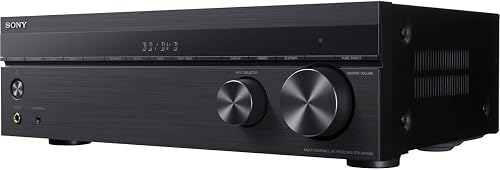
It's a 5.2-channel receiver with 4K HDR pass-through and HDCP 2.2 support, so it won't bottleneck a 4K source. Bluetooth streaming is built in, along with Bluetooth Standby, which lets you wake the receiver from your phone. There's also a multi-channel stereo mode, an FM tuner, and — increasingly rare — a 1/4-inch headphone jack on the front.
What it doesn't have: 8K, 4K/120, VRR or ALLM. If you own a current-generation console, this isn't your receiver.
Get it if: you want convincing surround from two speakers and don't need next-gen gaming features.
Sony STRDH590 5.2 Channel Surround Sound Home Theater Receiver
Onkyo TX-RZ50 — Best for Large or Difficult Rooms
At $1,049.95 this is the enthusiast pick, and the two things it puts on the box are the two things that matter at this level: 9.2 channels and THX certification. Nine channels means a 5.1.4 layout — four overhead speakers instead of two — which is where Atmos stops being a gimmick and starts being directional.
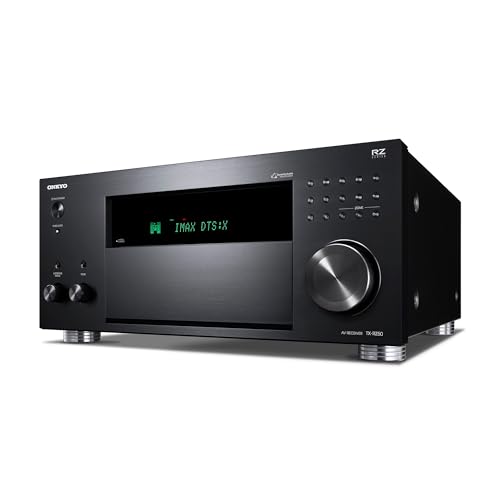
The headline feature is Dirac Live room correction. Dirac corrects both frequency response and impulse response, and it's the single most effective upgrade available for a room with bare walls, an open floor plan, or a seating position stuck against the back wall. No amount of speaker money fixes a bad room; correction software gets you most of the way there.
Onkyo's listing is thin on everything else, so check the manufacturer's spec sheet for power output, HDMI count and streaming support before ordering — and read through recent owner reviews yourself, since this is the one on this list where the price justifies the extra homework.
Get it if: you have a big or acoustically awkward room and want serious correction.
Onkyo TX-RZ50 9.2-Channel THX Certified AV Receiver
How to choose
Count your speakers, then add two. Channel count is the spec you can't upgrade around. A 5.2 receiver caps you at five speakers forever; 7.2 gets you 5.1.2 with heights; 9.2 gets you 5.1.4. Buy for the system you'll have in three years, not the one in the box today.
Check HDMI 2.1 inputs, not just "8K support." Several receivers advertise 8K but only route it through some inputs. The AVR-S570BT has four 8K inputs, the AVR-X1700H has three plus 8K upscaling on all six, and the RX-V6A has three of seven. If you own a PS5 or Xbox Series X, VRR and ALLM are the features that keep gaming smooth — the RX300A and AVR-S570BT both list them explicitly, the Sony doesn't.
Room correction beats watts. Automatic calibration measures your actual room and compensates. The RX300A includes a setup mic; the TX-RZ50 runs Dirac Live, which is a substantially more capable system. In a bad room, correction does more than doubling your amplifier power.
Decide whether it's also a music system. If the receiver is only for movies, ignore streaming specs. If it's your main music source, MusicCast on the RX-V6A and HEOS on the AVR-X1700H are the two full multi-room platforms here.
FAQ
Do I need Dolby Atmos? Only if you can place height speakers or up-firing modules. Without them, Atmos decoding does little on its own — though the AVR-X1700H's Height Virtualization and the RX300A's DTS Virtual:X both simulate the effect without physical height channels.
Is 8K support worth paying for? Not for 8K content, which barely exists. It's worth it because HDMI 2.1 also carries 4K/120, VRR and ALLM — the gaming features you'll actually use. The AVR-X1700H, AVR-S570BT, RX-V6A and RX300A all handle these.
Will a 70W receiver drive my speakers? For a normal living room with typical bookshelf or tower speakers, yes. The AVR-X1700H's 80W per channel gives you more headroom, and large or low-sensitivity speakers benefit — but room correction usually improves the result more than extra watts do.
How much should I spend? $400–$500 covers a full 5.1 system with modern video. Around $700 buys the extra channels for height speakers. Above $1,000 you're paying for advanced correction and 9-channel layouts, which pay off mainly in bigger or acoustically difficult rooms.
Related guides
- How to Choose an AV Receiver Without Overbuying
- How to Set Up a Turntable: A Beginner's Guide
- Best Turntables for Beginners in 2026
Key Takeaways
- Choosing the right best av receivers home theater means matching the key features to your specific needs and budget
- Read real customer reviews and check the return policy before you commit
- Compare value across models — the priciest option is not always the best fit